
8.12.2025
Holiday Shopping Ads: Where Do Consumers Really Look First?
 by Mirta Ivanek, Product Manager
The holiday season is a visual overload – flashing lights, festive colors, and endless promotions competing for our attention. But with all that sparkle, where do consumers actually look first? Eye tracking gives us the answer – and it’s not always where brands expect.
The Power (and Problem) of Holiday Visuals
Marketers love festive design. Snowflakes, ribbons, and glittery animations make ads feel joyful. But when every element is fighting for attention, the viewer’s eye doesn’t know where to land. Eye tracking studies often reveal that:
- Shoppers scan for familiar cues first – like logos or discount numbers (e.g., “-50%”)1
- Faces and products draw more attention than text2,3
- Over-decorated layouts dilute message clarity4
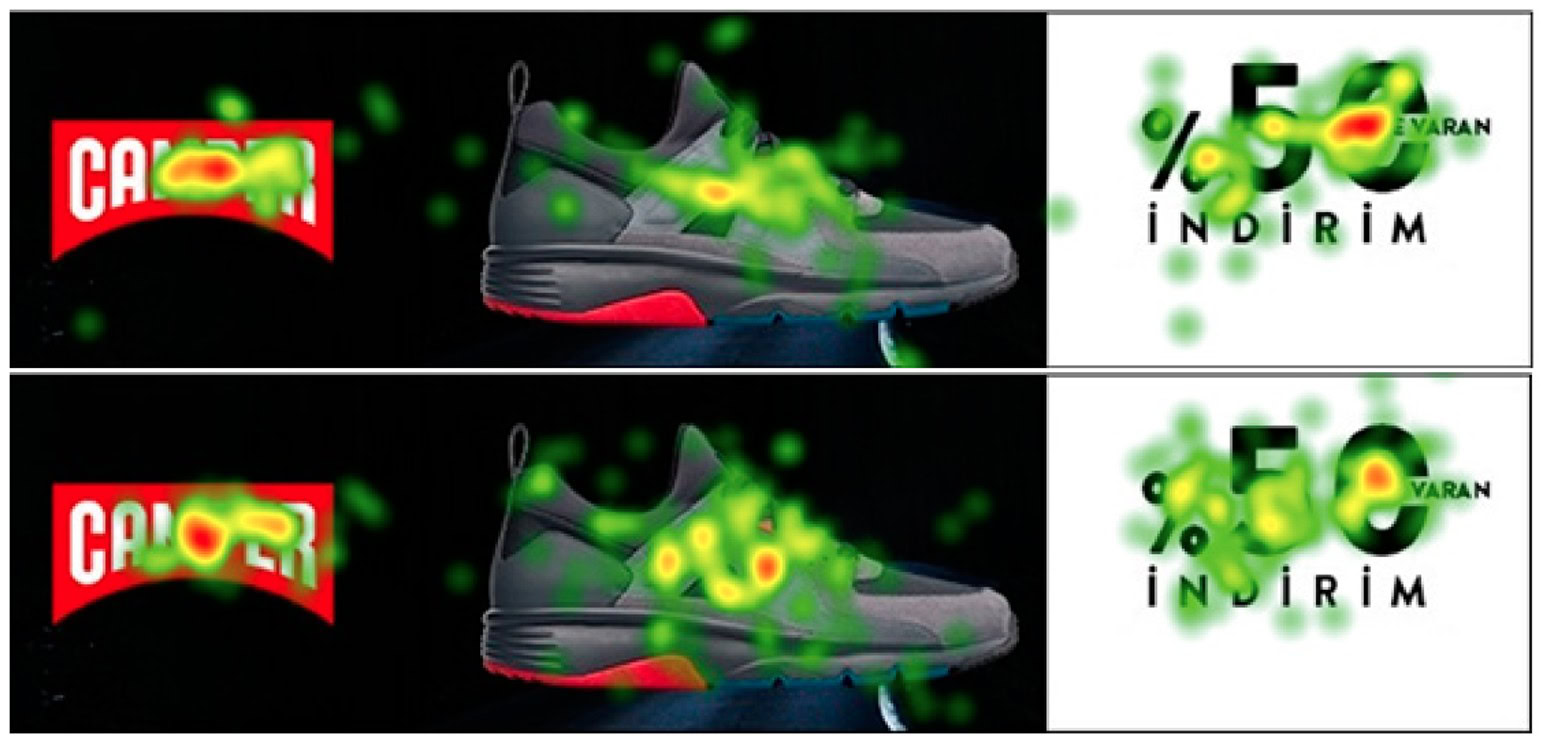
Comparison of heat maps for participants familiar with the brand (above) and those unfamiliar with it (below)1.
A “busy” ad might look cheerful, but it can also hide the most important information – like your offer or call-to-action (CTA).
Where Attention Really Goes
Across eye tracking studies of retail and e-commerce ads, a few consistent patterns emerge:
- Top-left bias: Western readers tend to start scanning from the top left – if your main offer sits elsewhere, it may be missed5,6
- Bright contrast wins: Red and yellow attract gaze, but overuse causes fatigue7
- Faces guide the gaze: Viewers follow the direction of a model’s eyes – use that to guide attention toward your product or CTA8
- Motion matters: Animated elements capture short bursts of attention, but can distract if overused9
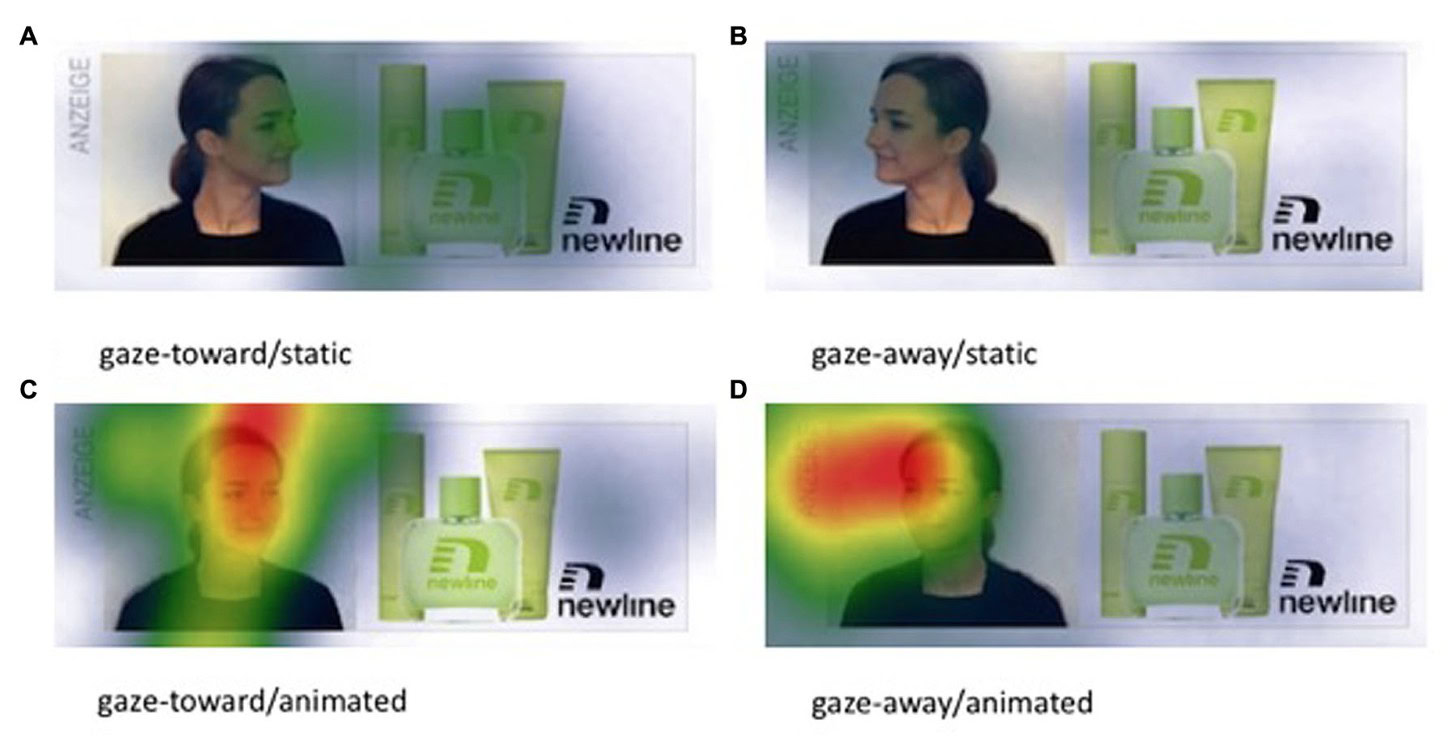
Heat maps showing total viewing time on the banner advertisement for the four experimental conditions (A-D), based on participants who first fixated on the banner. Fixation durations are scaled relative to other webpage elements and visualized with a blue-to-red gradient (minimum to maximum)8.
The key insight? Consumers’ eyes don’t move randomly – they follow psychological rules of attention and meaning.
What Smart Brands Do Differently
Leading brands now test their holiday campaigns with eye tracking and emotion metrics before launch. Instead of guessing, they see exactly:
- Which elements capture first fixation
- How long key visuals hold attention
- Whether the CTA gets noticed at all
Armed with this data, they tweak designs – often small changes like repositioning text or simplifying backgrounds – to make a huge difference in engagement and conversion.
Takeaway for Holiday Campaigns
The key lesson from eye tracking?
It’s not just about what’s shown – it’s about how attention flows.
Holiday ads that guide attention naturally through clear hierarchy, emotional connection, and balanced contrast perform better than those overloaded with decoration.
Smart visual design backed by eye tracking helps brands turn seasonal noise into meaningful engagement – and ensures the right eyes see the right message at the right time.
1
Peker, S., Menekse Dalveren, G.G., & Inal, Y. (2021). The Effects of the Content Elements of Online Banner Ads on Visual Attention: Evidence from an Eye-Tracking Study. Future Internet, 13(1), 18. https://doi.org/10.3390/fi13010018
2
Pieters, R., & Wedel, M. (2004). Attention Capture and Transfer in Advertising: Brand, Pictorial, and Text-Size Effects. Journal of Marketing, 68(2), 36-50.
3
Sajjacholapunt, P., & Ball, L.J. (2014). The influence of banner advertisement on attention and memory: human faces with averted gaze can enhance advertising effectiveness. Frontiers in Psychology, 5. https://doi.org/10.3389/fpsyg.2014.00166
4
Pilelienė, L., & Grigaliūnaitė, V. (2016). Effect of Visual Advertising Complexity on Consumers’ Attention. International Journal of Management, Accounting and Economics, 3(8), 489-501.
5
Leiva, L.A., Xue, Y., Bansal, A., Tavakoli, H.R., Köroglu, T., Du, J., Dayama, N.R., & Oulasvirta, A. (2020). Understanding visual saliency in mobile user interfaces. In Conference Proceedings – 22nd International Conference on Human-Computer Interaction with Mobile Devices and Services: Expanding the Horizon of Mobile Interaction, MobileHCI 2020 (Article 3403557). ACM. https://doi.org/10.1145/3379503.3403557
6
Ouyang, X., & Jia, L. (2022). The Presence of a Visual Dividing Line Increases Consumer Memory Through Attention Grabbing. Frontiers in Psychology, 13, Article 848471. https://doi.org/10.3389/fpsyg.2022.848471
7
Bortolotti, A., Cheung, V., Yu, L., Rhodes, A.P., & Palumbo, R. (2025). Decoding Color Perception: An Eye-Tracking Perspective. Journal of Sensory Studies, 40(2). https://doi.org/10.1111/joss.70044
8
Palcu, J., Sudkamp, J., & Florack, A. (2017). Judgments at Gaze Value: Gaze Cuing in Banner Advertisements, Its Effect on Attention Allocation and Product Judgments. Frontiers in Psychology, 8, 881. https://doi.org/10.3389/fpsyg.2017.00881
9
Lee. J., & Ahn, J.-H. (2012). Attention to banner ads and their effectiveness: An eye-tracking approach. International Journal of Electronic Commerce, 17(1), 119-137. https://doi.org/10.2307/41739506